Frequently Asked Questions

If you have a question, we might have an answer listed in these frequently asked questions.  You can always contact us at      440/334-8534 or email Dr. Feltes at:
dr.feltes@thebehaviorclinic.com

1. Why should I take my pet to see Dr. Feltes?

Horse with ColtDr. Feltes is a veterinarian with a medical practice limited to behavioral problems in dogs, cats, horses and birds.  As a veterinarian, she is not only in a position to evaluate your animal’s behavior but health as well.  An animal’s health & behavior are linked to each other.  Problems in one area will often cause problems in the other.

back to top

2. Why should I take my pet to see Dr. Feltes instead of a trainer?

There are no uniform standards for evaluating competency in animal trainers.  First of all, experience alone does not ensure proficiency to treat complex behavioral problems, such as aggression or compulsive disorders.  The ability to train an animal to perform obedience commands does not equate with a full knowledge of underlying medical issues. These medical issues may contribute to or even cause the behavioral problem.  The ability to train commands also does not equate to an ability to correctly diagnose and treat these problems.  While having your pet able to respond to obedience cues is helpful and often prescribed, it will NOT treat these complex problems alone!

back to top

3. What types of problems does Dr. Feltes see?

Currently, Dr. Feltes sees problem behaviors in dogs, cats, horses and birds.  Any behavior that is objectionable to a pet’s family can be seen for a consultation.  The following problem behaviors are one's seen by Dr. Feltes (but problems are not limited to these):  aggression (such as dog or cat-directed, human-directed, child-directed), excessive barking, fear (such as fear of being alone), phobias (such as thunderstorm phobia), unruliness (such as surfing counters for items to take or pulling on the leash), stereotypic disorders (ie. tail-chasing, self-mutilation, light-chasing), house training problems, litter box problems, urine marking, cognitive dysfunction (alzheimer's), scratching of furniture...

back to top

4. How do I know if my pet’s behavioral problem is significant enough to be seen by Dr. Feltes? 

If you are concerned enough to ask about your pet’s problem, it is worth talking to a professional for input!  Abnormal behavior is a problem if it is a problem for that pet’s family, impacts that pet's quality of life, or is a public health risk.  Therefore, even a pet’s normal behavior that is considered a problem for that pet’s family is warranted to have a consultation with Dr. Feltes.  An ethical solution can be found that improves your pet’s behavior, your relationship with your pet and your pet’s well being.  Please realize that the longer your pet engages in a behavior, the longer it will take to treat it.  The sooner you get your pet in for a consultation, the better for you and your pet.  As a general rule, if the problem behavior is increasing in frequency, intensity or has lasted longer than 2 weeks – seek help!

back to top

5. Is there a guarantee? 

Unfortunately no guarantees can be given regarding the outcome of your pet’s behavior plan.  It is misleading for a business to give you specific guarantees regarding behavior problems in pets, particularly such problems as aggression.  No animal is 100% predictable 100% of the time and as such, a guarantee for that animal is not reasonable, responsible or ethical.

back to top

6. What should I expect during my consultation? 

Please dress comfortable for your appointment.  All cat, horse or bird appointments are in your home/stable, as Dr. Feltes feels that is the most useful in evaluating the environmental contributions to the problem.  Also, it greatly reduces the stress on these animals to avoid travel.  Dog consultations can be done in The Behavior Clinic or at your home.  Please note, travel to the in-home appointments has an additional fee.  Please make sure to have any training equipment handy that you use with your pet on a regular basis.  We also encourage (but do no require) you to provide a short (less than 10 minutes) video clip of your pet’s problem behavior if this can be done safely and ask for that to be sent in advance of the consult if possible.  Your pet will be given food rewards for good behavior during the consult.  If your pet requires a special diet, please have some acceptable treats that your pet loves available.  During your appointment, the history questionnaire will be reviewed in detail.  Demonstration of some techniques will be done if your pet is comfortable enough to participate in them.  Any medical recommendations (to be performed through your local veterinarian) will be discussed at this time.  You will receive 10-20 handouts to aide in instituting the plan.  The initial consultation typically lasts around 2 hours.  A detailed summary sheet with the full plan will be sent within 7 business days of the consult to both you and your Veterinarian.  Follow-up is included with the consultation (10 minute phone calls on every other Tuesday) for 4 months.  You are also encouraged to email or fax bi-weekly logs of your pet’s behavior for Dr. Feltes to review and aide in alterations to your pet’s plan.  Recheck appointments with Dr. Feltes are recommended based on progress and are at a minimum recommended every 4 months.  These appointments typically last around 1 hour. Training rechecks with our veterinary behavioral technician, Amanda Eick-Miller RVT, CPDT-KA may be recommended. This is often during therapy to aide in implementation of the plan or beyond to ensure progress is made and maintained.

back to top

7. Will medication be recommended for every pet? 

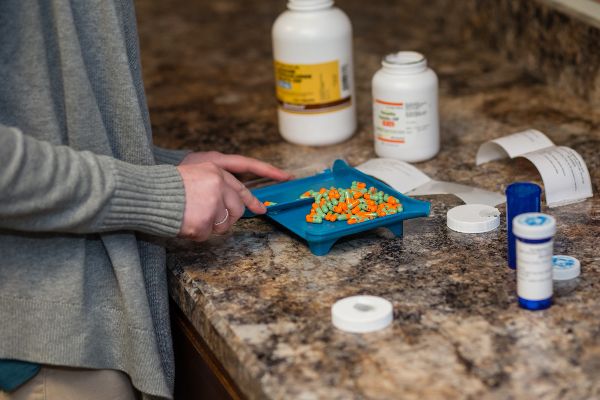
Dr. Feltes may recommend medication, as an adjunct to your pet’s behavior modification plan.  Not every pet needs medication and the recommendation is only made when needed.  The doctor does not use medication in a cavalier manner, and the pros and cons will be discussed with you during the consultation.  No medication labeled for behavioral problems in pets is labeled for use without environmental changes and behavior modification plans.  Additionally, many of the medications used for problem behaviors in companion animals are used off-label. This means that the drug company has not labeled and tested the medication for that particular use in that particular species. Many clients worry about maintaining their pet on medication for a longer period of time. However, these medications typically take time to change brain chemistry and therefore behavior. They should not be started and stopped abruptly unless under the direct guidance of a veterinarian. Additionally, most pets relapse in the future if medication is used as the sole treatment.  Medication alone will NOT resolve your pet’s behavior problem.

back to top

8. Do I bring my pet?

It is required to bring your pet to the consultation.  If your pet or you cannot do stairs, the consultation needs to take place in your home as there is a full flight of stairs at The Behavior Clinic.  If you feel other family pets are involved in the problem, those pets should attend as well.  All cat and bird appointments are always in your home, not at The Behavior Clinic and all horse consults are seen at your stable.

back to top

9. How do you get my pet’s medical and training records? 

Please contact your veterinary clinic and have a Referral Form faxed to The Behavior Clinic once you have scheduled a consultation. If you have been working closely with a trainer, please ask them to write an email to Dr. Feltes (dr.feltes@thebehaviorclinic.com) regarding your pet's training history.

back to top

10. How much does a consult cost? 

Consultations are charged based on the amount of time you meet with Dr. Feltes.  As stated above, initial consultations typically last around 2 hours and include 4 FREE months of phone follow up.  The fee is $150 per hour.  For consultations in your home/stable, the travel fee is $30 for the first 10 miles and $20 for every 15 miles thereafter (maximum travel fee is $100).  This is charged only one way.  The Behavior Clinic accepts Visa, Mastercard, Cash, Personal Check and Care Credit. Shelters, Rescue Groups and Foster Homes are eligible for a $30 discount per hour. Recheck Consultations are often recommended. Rechecks with Dr. Feltes cost $90 per hour and typically last about 1 hour, occurring typically 3-4 months after the initial consult. Training Rechecks with our veterinary behavioral technician, Amanda Eick-Miller, RVT cost $75 for an hour session. Travel fees occasionally apply depending on location. These are often recommended during the therapy to ensure progress is kept on track or after its completion to maintain the progress made and for further education. These are currently being routinely offered on Tuesdays between 10am and 6pm. A Progress Package is also offered: 4 Training Rechecks for $285- a 5% discount- with guaranteed waiver of any associated travel fees. Package must be used within 3 months of purchase.

back to top

11. How do I schedule a consultation? 

Please contact The Behavior Clinic at 440/334.8534 to schedule a consultation.  A behavioral history form can be downloaded from our website (under the Consultations tab at the top).  This form allows Dr. Feltes to make recommendations that you can live with – she does not live with you but her recommendations need to!  The forms may feel overwhelming due to their length but are necessary to allow her a complete picture of your situation.  Please note, a Visa or Mastercard needs to be provided to reserve an appointment slot.  The Reservation Fee assessed on the credit card is $50. Time & Date adjustments may be made up to 48 hours prior to the appointment and the fee will be credited to your consultation bill. However, if adjustments are made to the scheduled slot within the 48 hours before the appointment date or if the appointment is cancelled altogether, no credits will apply. In the event of a cancelled appointment for an in-home consult and Dr. Feltes did not know until she arrives (no show), a travel fee will also be assessed.